Multifocal motor neuropathy, commonly called MMN, is a rare neurological disorder that primarily affects the motor nerves controlling voluntary muscle movement.
For many people, the first signs can be subtle.
A hand may become weaker. Objects may suddenly be easier to drop. Turning a key or opening a container may become harder. Some people develop weakness in a foot or leg that changes the way they walk.
Because MMN can resemble other neurological disorders, receiving an accurate diagnosis is particularly important.
The good news is that MMN is treatable, and intravenous immunoglobulin, or IVIG, is the primary established therapy for the condition. NORD and the GBS/CIDP Foundation describe IVIG as the main treatment for MMN, with repeated treatment often required to maintain benefit. National Organization for Rare Disorders
What Is Multifocal Motor Neuropathy?
Multifocal motor neuropathy is a rare, chronic, immune-mediated peripheral nerve disorder.
The name itself helps describe the disease:
Multifocal means that multiple individual nerve areas can be affected.
Motor refers to the nerves controlling muscle movement.
Neuropathy means disease or dysfunction of peripheral nerves.
In MMN, abnormal immune activity interferes with the ability of certain motor nerves to transmit signals efficiently to muscles.
The result is typically slowly progressive muscle weakness.
What Are the Symptoms of MMN?
MMN commonly causes weakness that is asymmetric, meaning the same muscles may not be affected equally on both sides of the body.
Symptoms frequently begin in the arms or hands.
They can include:
- Hand weakness
- Reduced grip strength
- Difficulty turning keys
- Difficulty opening containers
- Dropping objects
- Trouble using fingers for fine motor tasks
- Wrist drop
- Foot drop
- Leg weakness
- Muscle cramps
- Muscle twitching
- Muscle wasting over time
Symptoms typically progress gradually rather than appearing throughout the body all at once. National Organization for Rare Disorders
Does MMN Cause Numbness or Tingling?
One of the characteristics that can help distinguish MMN from many other neuropathies is the relative absence of significant sensory symptoms.
A patient may have substantial weakness while experiencing little or no:
- Numbness
- Tingling
- Burning
- Sensory loss
- Neuropathic pain
That doesn’t mean every patient’s presentation is identical.
But the combination of motor weakness with minimal sensory loss is an important feature neurologists consider when evaluating MMN. National Organization for Rare Disorders
Why Is MMN Sometimes Difficult to Diagnose?
MMN is uncommon.
Its symptoms can also resemble other neurological or neuromuscular conditions.
The differential diagnosis may include disorders such as:
- Amyotrophic lateral sclerosis
- Chronic inflammatory demyelinating polyneuropathy
- Other inflammatory neuropathies
- Nerve-compression disorders
- Certain muscle disorders
This is one reason evaluation by a neurologist—particularly a neurologist familiar with neuromuscular conditions—is important.
MMN vs. ALS
MMN and amyotrophic lateral sclerosis can both involve progressive motor weakness.
However, they are different disorders.
MMN affects peripheral motor nerves and often responds to immunoglobulin treatment.
ALS involves progressive degeneration of motor neurons and follows a different disease process.
Certain clinical and electrodiagnostic findings can help specialists distinguish between the two.
Early differentiation matters because MMN has a specific treatment that can improve function in many patients. NINDS notes that MMN is sometimes mistaken for ALS but differs in its treatment responsiveness. NINDS
How Is Multifocal Motor Neuropathy Diagnosed?
Diagnosis usually involves a combination of:
- Medical history
- Neurological examination
- Pattern of weakness
- Nerve conduction studies
- Electromyography
- Blood testing in some patients
- Exclusion of other neurological disorders
No single symptom should be used to self-diagnose MMN.
What Is a Nerve Conduction Study?
A nerve conduction study measures how effectively electrical signals travel through peripheral nerves.
Electrodes are placed on the skin, and small electrical impulses are used to evaluate how nerves transmit signals.
One important finding associated with MMN is motor conduction block.
This occurs when electrical impulses have difficulty traveling through a segment of a motor nerve.
Conduction block in characteristic locations can strongly support an MMN diagnosis. National Organization for Rare Disorders
What Is an EMG?
Electromyography, or EMG, is often performed along with nerve conduction studies.
A small needle electrode records electrical activity within selected muscles.
The information can help physicians determine whether weakness appears to originate primarily from:
- Muscle
- Peripheral nerves
- Motor neurons
- Another neuromuscular process
These tests help the neurologist build a more complete picture.
What Are Anti-GM1 Antibodies?
Some people with MMN have antibodies directed against a nerve-associated molecule called GM1 ganglioside.
A blood test may therefore be performed as part of the evaluation.
However, the absence of detectable anti-GM1 antibodies does not automatically rule out MMN.
Diagnosis still relies heavily on the overall clinical presentation and electrodiagnostic findings. National Organization for Rare Disorders
How Is Multifocal Motor Neuropathy Treated?
The primary established treatment for MMN is intravenous immunoglobulin therapy.
IVIG is produced from immunoglobulin collected from screened donor plasma and contains antibodies that can modify immune activity.
For MMN, treatment can improve nerve function and muscle strength in many patients.
It is not considered a cure, however.
Because the effect of IVIG can wear off, patients who benefit frequently require ongoing maintenance infusions. National Organization for Rare Disorders
Patients can learn more about Mercy Infusion’s IVIG and specialty infusion services.
Has Your Neurologist Prescribed IVIG for MMN?
Mercy Infusion can help coordinate the administrative and clinical logistics involved in starting physician-prescribed therapy.
Our team can assist with:
- Referral intake
- Benefits verification
- Prior authorization
- Medication access
- Physician communication
- Nursing coordination
- Treatment scheduling
Call Mercy Infusion at 833-594-0124 to discuss your MMN infusion referral.
How Does IVIG Help MMN?
MMN is believed to involve abnormal immune activity directed against peripheral motor nerves.
IVIG can modify immune activity through multiple mechanisms.
Clinically, patients who respond may experience:
- Improved strength
- Better hand function
- Improved mobility
- Greater ability to perform daily activities
- Stabilization of disease progression
The degree and duration of improvement vary considerably between patients.
How Quickly Can IVIG Work for MMN?
Responses differ.
Some patients experience relatively noticeable improvement after initial therapy, while the response may be slower or less dramatic for others.
NINDS notes that improvement in strength may begin within several weeks in patients who respond. NINDS
The treating neurologist may monitor:
- Strength
- Grip
- Hand function
- Mobility
- Walking
- Functional ability
- Symptom recurrence between doses
The treatment schedule may then be adjusted based on clinical response.
How Often Is IVIG Given for MMN?
There is no single schedule appropriate for every patient.
Patients may initially receive a loading course followed by recurring maintenance treatment.
The exact:
- Dose
- Frequency
- Number of infusion days
- Infusion rate
depends on physician orders and individual response.
Many patients who respond require repeated treatment because the benefit of IVIG is temporary. Specialty sources describe maintenance intervals commonly measured in weeks rather than months, but the actual schedule must be individualized by the treating neurologist. National Organization for Rare Disorders
Can MMN IVIG Be Given at Home?
For appropriate, medically stable patients, physician-prescribed IVIG may potentially be administered at home.
Home therapy may reduce repeated trips to hospitals or outpatient centers for people requiring long-term treatment.
Mercy Infusion’s Home Infusion program supports eligible patients receiving physician-directed IVIG and other specialty therapies.
Whether home infusion is appropriate depends on:
- Physician orders
- Patient stability
- Treatment history
- IV access
- Medication
- Nursing requirements
- Insurance authorization
What Happens During Home IVIG?
Treatment logistics vary, but home IVIG may involve:
- Medication and supplies being coordinated before treatment.
- A qualified infusion nurse arriving at the patient’s home.
- Reviewing the treatment order and assessing the patient.
- Establishing or accessing the IV.
- Administering the medication according to the prescribed protocol.
- Monitoring the patient during treatment.
- Coordinating future treatments.
Patients who want more detail can read What to Expect During Home IVIG Therapy.
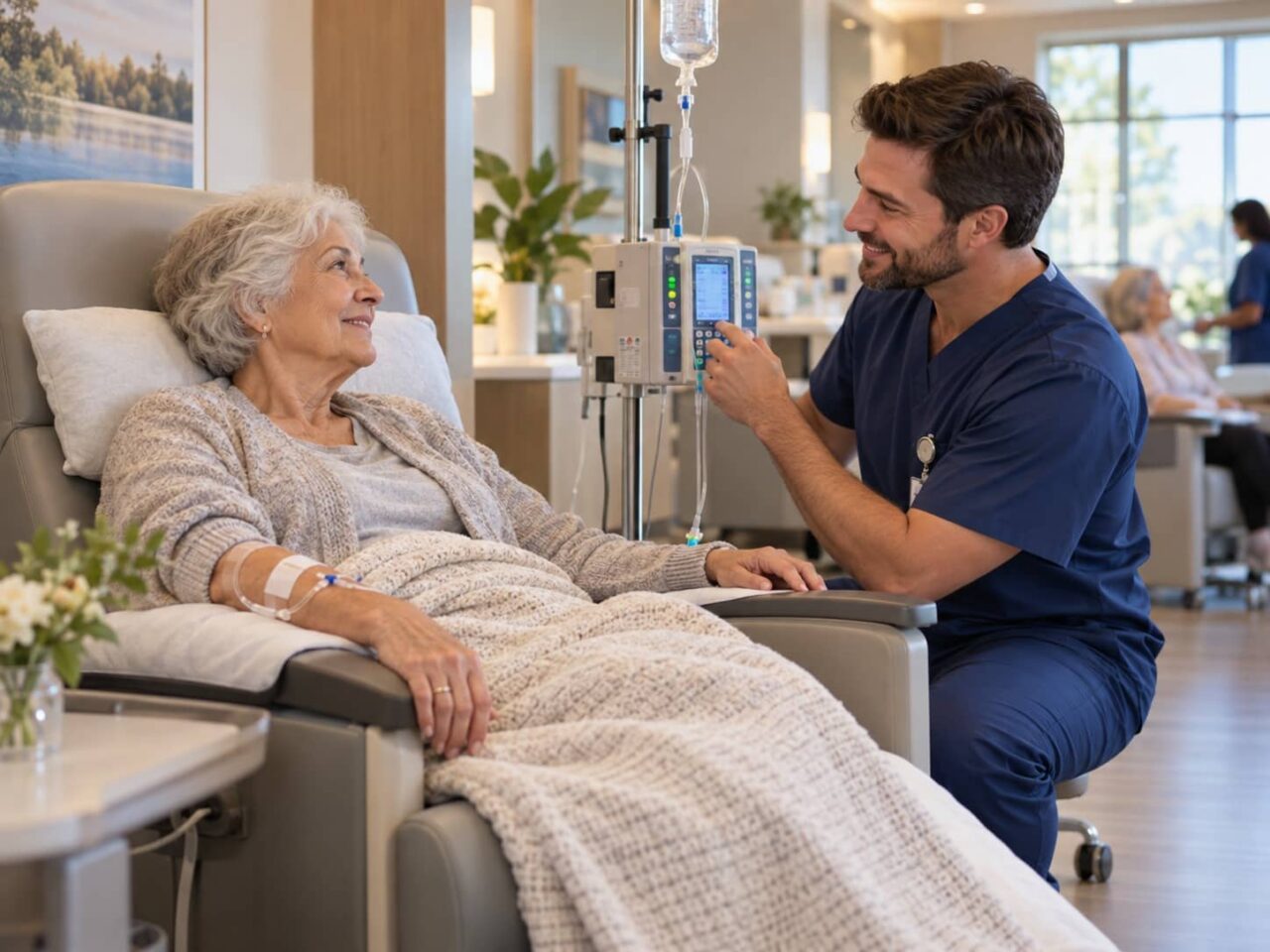
Can MMN Be Treated in an Infusion Suite?
Yes, depending on the patient’s treatment plan and insurance coverage.
Some patients prefer an outpatient infusion environment rather than treatment at home.
The appropriate site of care may depend on:
- Patient preference
- Insurance
- Nursing needs
- Clinical status
- Physician recommendations
- Scheduling
Mercy Infusion can help evaluate available treatment-setting options after receiving the physician’s order.
Insurance and Prior Authorization for MMN IVIG
IVIG is a specialty medication, and insurance plans may require prior authorization.
The authorization process may involve documentation of:
- MMN diagnosis
- Neurological examination
- Nerve conduction findings
- Treatment history
- Medical necessity
- Prescribed dose and frequency
Additional documentation may sometimes be requested before approval.
Mercy Infusion helps coordinate benefits verification and prior authorization as part of its referral process.
What if Insurance Delays IVIG Approval?
A delay does not necessarily mean treatment has been permanently denied.
Possible reasons can include:
- Missing clinical documentation
- Additional insurer requirements
- Incomplete diagnostic records
- Network restrictions
- Site-of-care requirements
- Need for clarification from the neurologist
The infusion provider and physician’s office may need to work together to supply additional information.
Is IVIG a Cure for MMN?
No.
IVIG can improve or stabilize symptoms in many patients, but MMN is generally managed as a chronic condition.
Treatment may need to continue over time to maintain benefit.
This is why regular neurological follow-up remains important even when infusion therapy is working well.
Living With MMN
Weakness in the hands, arms, feet, or legs can affect everyday activities that most people take for granted.
Some patients may also benefit from:
- Physical therapy
- Occupational therapy
- Assistive devices
- Braces for foot or wrist weakness
- Workplace modifications
- Strategies for conserving energy
Treatment goals should focus not only on test results but also on maintaining independence and function.
Ready to Start Physician-Prescribed IVIG for MMN?
If your neurologist has diagnosed multifocal motor neuropathy and prescribed IVIG, Mercy Infusion can help coordinate treatment.
Our team can assist with:
- Insurance benefits verification
- Prior authorization
- Physician-office communication
- Specialty medication coordination
- Nursing
- Home infusion
- Outpatient infusion options
- Treatment scheduling
- Copay-assistance resources when available
Patients concerned about financial responsibility can also review Mercy Infusion’s Copay Assistance resources.
Call Mercy Infusion at 833-594-0124 or contact our team online to discuss starting your physician-prescribed MMN infusion therapy.
Frequently Asked Questions About Multifocal Motor Neuropathy
Is MMN an autoimmune disease?
MMN is generally considered an immune-mediated disorder in which abnormal immune activity affects peripheral motor nerves. National Organization for Rare Disorders
Is MMN the same as ALS?
No. Both can cause muscle weakness, but they are different neurological disorders with different disease mechanisms and treatment options.
Does MMN cause numbness?
Significant sensory symptoms are generally not characteristic of MMN. Weakness with little or no sensory loss is an important feature of the condition. National Organization for Rare Disorders
What is conduction block?
Conduction block occurs when electrical signals do not travel normally through a segment of a motor nerve. Nerve conduction studies can identify this pattern and help support an MMN diagnosis.
Is IVIG used to treat MMN?
Yes. IVIG is the principal established immunotherapy for MMN and can improve strength and function in many patients. National Organization for Rare Disorders
Does IVIG cure MMN?
No. IVIG can improve or stabilize the condition, but ongoing treatment is commonly necessary.
Can IVIG for MMN be administered at home?
Some medically stable patients can receive physician-prescribed IVIG at home when the clinical team and insurer determine home therapy is appropriate.
Medical Disclaimer: This article is for general educational purposes only and does not replace diagnosis or treatment recommendations from a neurologist or other qualified healthcare professional.


