
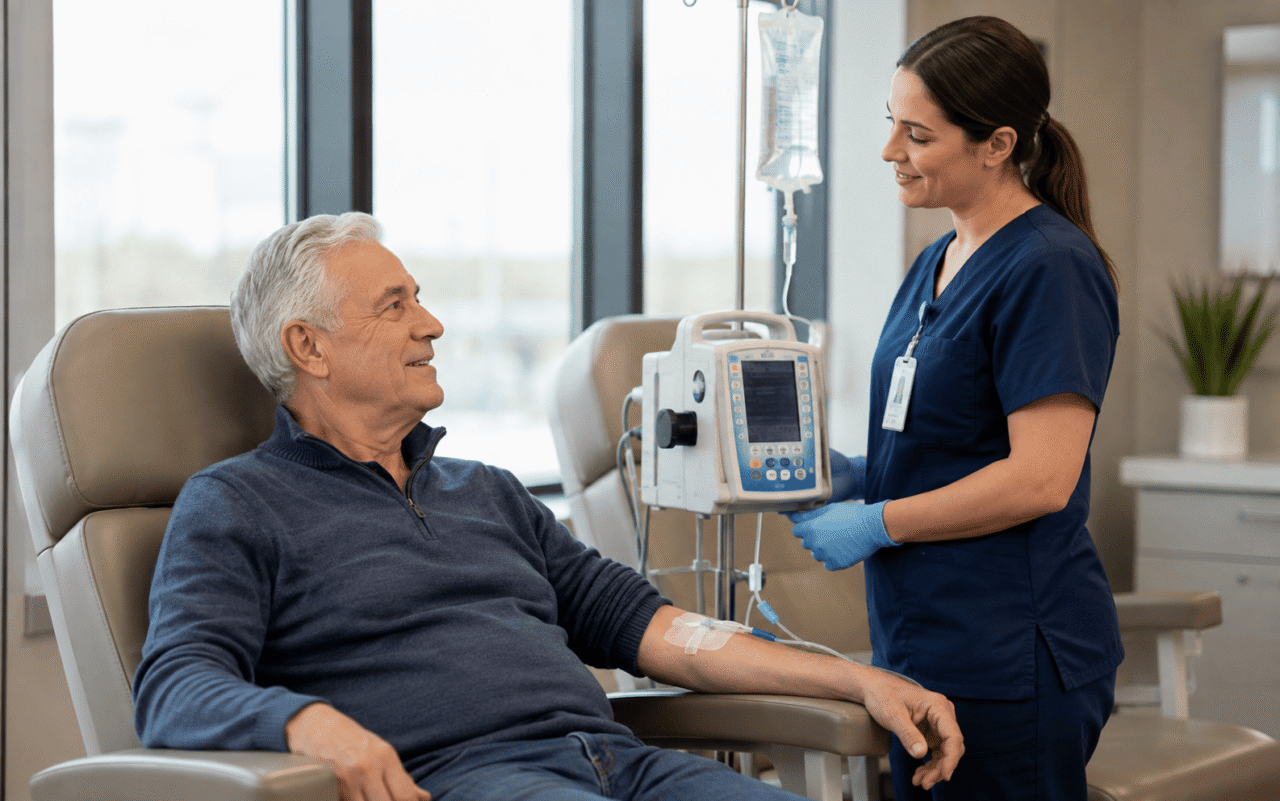
Many medications that once required patients to remain in a hospital can now be administered at home for appropriately selected patients.
Home infusion therapy can involve intravenous or subcutaneous medications, specialized equipment, pharmacy services, nursing support, patient education, and ongoing coordination with the prescribing physician.
CMS describes home infusion therapy as intravenous or subcutaneous administration of drugs or biologicals in a patient’s home. Treatment may require the medication itself, an infusion pump, tubing and catheters, supplies, and nursing services for education, monitoring, and site assessment.
The exact medications that can be provided at home depend on:
- Prescription
- Medical condition
- Medication
- Stability
- Monitoring requirements
- Patient or caregiver abilities
- Home environment
- Nursing availability
- Insurance authorization
Not every medication or patient is appropriate for home care.
Interested in Receiving Infusion Therapy at Home?
Mercy Infusion can review your physician’s prescription, clinical requirements, insurance benefits, and home-infusion eligibility.
Explore Home Infusion
Call 833-594-0124
- Immunoglobulin Therapy
Immunoglobulin is one of the most recognizable categories of home infusion treatment.
IVIG
Intravenous immunoglobulin is administered through a vein.
Depending on the product and condition, IVIG may be prescribed for certain:
- Primary immune deficiencies
- Neurologic disorders
- Autoimmune conditions
- Hematologic disorders
The FDA maintains a list of licensed IVIG products including Gammagard Liquid, Gamunex-C, Octagam, Privigen, Panzyga, Asceniv, Bivigam, and others. Indications vary by product.
Eligible patients may receive physician-prescribed IVIG therapy at home with nursing support.
SCIG
Subcutaneous immunoglobulin is administered under the skin rather than into a vein.
FDA-licensed SCIG products include Hizentra, Cuvitru, Xembify, HyQvia, Cutaquig, and others.
Certain patients can eventually self-administer SCIG after appropriate training and physician approval.
Read more about IVIG vs. SCIG.
- Intravenous Antibiotics
Some bacterial infections require IV antibiotics rather than oral medication.
For medically stable patients, part of the antibiotic treatment course may sometimes be completed at home under physician direction.
Home antibiotic therapy can require:
- Correct medication storage
- IV access
- Dose timing
- Pump or gravity administration
- Laboratory monitoring
- Nursing assessment
- Line care
- Physician follow-up
A patient being discharged from the hospital may transition to home IV therapy when the treating healthcare team determines that hospital-level care is no longer necessary.
Home infusion should not be confused with self-treatment. The drug, dose, duration, monitoring requirements, and appropriate site of care must be established by qualified healthcare professionals.
- Specialty Biologic Medications
Biologic medications are used for several immune-mediated and inflammatory diseases.
Some physician-prescribed biologics may be administered by infusion at home when:
- The specific medication allows it
- The patient is clinically appropriate
- Monitoring needs can be met
- Nursing is available
- Insurance authorizes home treatment
Other biologics may require an infusion center or another supervised clinical setting.
Patients should not assume that because one biologic can be administered at home, another can as well.
The treatment plan is medication-specific.
- Parenteral Nutrition
Some patients cannot adequately absorb or consume nutrients through the gastrointestinal tract.
Parenteral nutrition provides nutrients directly into the bloodstream.
Depending on the prescription, the solution may contain:
- Amino acids
- Glucose
- Lipids
- Electrolytes
- Vitamins
- Minerals
- Other prescribed components
Home parenteral nutrition is a highly coordinated therapy and may require:
- Central venous access
- Sterile technique
- Pump equipment
- Laboratory monitoring
- Nutrition management
- Pharmacy compounding
- Patient or caregiver training
- Regular clinical follow-up
It is not simply a standard IV fluid.
The prescription may need to change over time based on laboratory results, weight, hydration status, and nutritional requirements.
- IV Hydration and Electrolyte Therapy
Some patients may be prescribed IV fluids because they cannot maintain adequate hydration through oral intake or because of another physician-diagnosed medical need.
Prescribed solutions may contain:
- Saline
- Dextrose
- Electrolytes
- Other physician-ordered components
The need for home hydration should be medically determined.
Patients should not independently obtain IV hydration or electrolyte treatment as a substitute for evaluation of dehydration or another medical condition.
- Certain Antiviral or Antifungal Therapies
Like antibiotics, selected intravenous antiviral or antifungal medications may sometimes be administered outside the hospital when the patient is stable and the care plan supports it.
Home therapy may involve:
- Specialty pharmacy preparation
- IV access
- Pump equipment
- Nursing
- Laboratory monitoring
- Dose adjustments
- Physician follow-up
CMS specifically identifies antivirals and immune globulin as examples within home-infusion services.
- Other Specialty Infusion Therapies
Home-infusion pharmacies may coordinate additional physician-prescribed therapies depending on their capabilities, licensing, clinical protocols, nursing, and payer contracts.
These may include selected treatments for:
- Neurologic disorders
- Immune disorders
- Gastrointestinal conditions
- Inflammatory diseases
- Rare diseases
- Other chronic conditions
Patients should contact the infusion provider regarding a specific drug rather than assuming all infused medications are available for home administration.
Why Can Some Medications Be Given at Home and Others Cannot?
Several factors determine the appropriate treatment setting.
Reaction Risk
Some medications have a higher potential for immediate reactions and may require closer clinical observation.
First Dose
A physician may prefer that the first dose occur in a facility before transitioning home.
Monitoring Requirements
Some therapies require:
- Frequent vital signs
- Laboratory testing
- Observation
- Specialized equipment
- Immediate access to additional clinical resources
Medical Stability
A medically unstable patient may require hospital-level care regardless of the medication.
Product Instructions
Some medications have administration requirements that affect site of care.
Insurance
An insurer may require a specific:
- Pharmacy
- Nursing provider
- Medication
- Site of care
- Prior authorization
Home infusion therefore involves both a clinical decision and a coverage decision.
What Does the Home Infusion Pharmacy Provide?
Depending on the therapy, a home-infusion provider may coordinate:
- Medication preparation
- Medication delivery
- Infusion pumps
- Tubing
- IV supplies
- Dressing supplies
- Needles or catheters
- Ancillary medications
- Nursing
- Patient education
- Pharmacy support
CMS notes that home infusion often requires coordination among the patient, physician, hospital discharge team, insurer, home-infusion pharmacy, and nursing providers.
What Does the Home Infusion Nurse Do?
Depending on the prescription, the nurse may:
- Assess the patient
- Review symptoms
- Check vital signs
- Establish or assess IV access
- Administer treatment
- Monitor for reactions
- Change dressings
- Educate the patient
- Assess the infusion site
- Communicate concerns to the physician or pharmacist
CMS specifically describes nursing education, infusion-site assessment, dressing changes, and monitoring as important parts of home infusion.
Do Patients Ever Administer Their Own Medication?
Yes, with selected therapies.
Patients or caregivers may be trained to administer certain home infusion medications when the physician, pharmacist, and clinical team determine that it is appropriate.
For example, certain SCIG products are designed around home administration.
That does not mean patients should independently administer IV medications without formal training.
Education may include:
- Hand hygiene
- Medication storage
- Equipment setup
- Infusion-site preparation
- Pump operation
- Line flushing
- Disposal
- Reaction recognition
- When to contact the clinical team
Who Qualifies for Home Infusion?
Eligibility depends on more than which medication has been prescribed.
A patient may need:
- A physician’s order
- Medical stability
- A medication appropriate for home administration
- Appropriate monitoring needs
- Suitable IV or other access
- A safe home environment
- Nursing availability
- Insurance authorization
Read our full guide to who qualifies for home infusion.
Home Infusion vs. Infusion Center
Both can be appropriate.
Home Infusion
May provide:
- Less travel
- Greater privacy
- Familiar environment
- One-on-one nursing
- Convenient recurring treatment
Infusion Suite
May provide:
- Structured clinical environment
- On-site healthcare professionals
- Closer monitoring
- No medication storage at home
- A setting for patients who are not appropriate for home therapy
Patients can read our comparison of home infusion vs. infusion-center care.
Does Insurance Cover Home Infusion Medications?
Coverage varies.
The insurer may review:
- Medication
- Diagnosis
- Medical necessity
- Dose
- Frequency
- Provider network
- Pharmacy network
- Prior authorization
- Site of care
- Nursing
- Supplies and equipment
Mercy Infusion verifies benefits and helps coordinate authorization through its intake process.
What If the Medication Is Expensive?
Even when covered, patients may have:
- Deductibles
- Copays
- Coinsurance
Depending on the treatment and insurance, copay assistance or other financial-support resources may be available.
Eligibility and patient cost cannot be guaranteed.
Frequently Asked Questions About Home Infusion Medications
Is IVIG commonly given at home?
Yes, medically appropriate patients may receive physician-prescribed IVIG at home.
Can antibiotics be administered at home?
Certain patients may complete prescribed IV antibiotic treatment at home when their healthcare team determines that it is safe and appropriate.
Can biologics be given at home?
Some can. The medication, prescribing information, clinical requirements, physician direction, and insurer determine the appropriate setting.
What is parenteral nutrition?
Parenteral nutrition delivers prescribed nutrients intravenously when adequate nutrition cannot be provided through the gastrointestinal tract.
Does a nurse have to administer every home infusion?
Not necessarily. Some therapies may be self-administered after training, while others require nursing.
Can I choose home infusion instead of a hospital?
Patient preference is considered, but clinical appropriateness and insurance authorization also matter.
Does Mercy provide all IV medications?
No infusion provider should assume that every medication can be provided in every setting. Patients should contact Mercy regarding their specific prescription.
Find Out Whether Your Medication Can Be Given at Home
If you or a loved one has been prescribed an infusion medication, Mercy Infusion can help review:
- Prescription
- Insurance coverage
- Prior authorization
- Home-infusion eligibility
- Nursing needs
- Medication and supplies
- Financial-support options
- Treatment scheduling
Explore Home Infusion
See How the Intake Process Works
Call 833-594-0124
About the Author
April Cable, Senior Director of Operations
April Cable has more than 35 years of experience in specialty pharmacy billing, reimbursement, operations, and patient access. She helps patients and families navigate insurance, prior authorization, medication access, financial support, and the operational steps required to begin and maintain specialty infusion therapy.
This article is for general educational purposes. The prescribing physician and clinical team must determine whether a medication and home-infusion setting are appropriate for an individual patient. Medication availability, insurance authorization, nursing, financial assistance, and treatment timing cannot be guaranteed.


